
Tuscola County Circuit Court Overview
The 54th Judicial Circuit Court is the trial court with the widest reach in Tuscola County. It hears felony criminal cases, civil actions over $25,000, and any case type not assigned by law to another court. The family division sits inside this circuit structure as well. Hon. Amy Grace Gierhart serves as Chief Judge. The court operates from the Tuscola County Courthouse at 440 N State St in Caro.
Circuit business is spread across a few phone lines. The assignment clerk handles scheduling at 989-673-3330, the court administrator can be reached at 989-672-3807, and circuit and family records run through 989-672-3775. Transcripts are ordered by calling 989-672-3720. Felony cases reach the circuit only after the district court holds early hearings, so the two courts work in sequence on serious charges.
General jurisdiction means the circuit court can hear any matter the law does not hand to another court. That includes injunctions, appeals from some agency decisions, and civil suits with large money claims. The Prosecuting Attorney files criminal charges for the People from an office nearby at 207 E Grant St, and the Sheriff's Office at 420 Court St handles arrests and jail custody, so a single criminal matter may involve several buildings in central Caro.
Tuscola County Courts and Offices
All of the county's main court offices share the courthouse campus in Caro, which keeps circuit, district, probate, and family functions close together. Each office owns a different set of records and case types. The table lists the courts and support offices a records researcher will most often need, with their roles and contacts.
| Court / Office | Role | Address | Phone |
|---|---|---|---|
| 54th Judicial Circuit Court | Felony criminal, civil over $25,000, general jurisdiction, family division | 440 N State St, Caro, MI 48723 | Assignment 989-673-3330; records 989-672-3775 |
| 71B District Court | Misdemeanors, traffic, civil infractions, landlord-tenant, small claims, civil up to $25,000, felony prelims | 440 N State St, Caro, MI 48723 | 989-672-3800; magistrate 989-672-3790 |
| Tuscola County Probate Court | Estates, trusts, guardianships, conservatorships, mental health, will safekeeping | 440 N State St, Caro, MI 48723 | 989-672-3850; fax 989-672-2057 |
| Family Division | Family cases attached to the circuit and probate structure | 440 N State St, Caro, MI 48723 | Scheduling 989-672-3850; records 989-672-3775 |
| Friend of the Court | Child support, custody, and parenting-time enforcement | 440 N State St, Caro, MI 48723, first floor | 989-673-4848; IVR 877-543-2660 |
Two features of the table are worth noting. First, the records line and the scheduling line are different numbers, so calling the right one the first time matters. Second, filings cannot be sent by fax, since the county directory states that faxed pleadings or supplemental case filings will not be accepted. Documents that must reach the court go to the proper clerk counter instead.
Circuit vs District vs Probate Court
Michigan sorts trial cases by type and by the money at stake. The circuit court takes the most serious criminal and civil matters. The district court is the limited-jurisdiction court for smaller disputes and early criminal stages. The probate court has its own statutory subjects, mostly estates and protective proceedings. The comparison shows how the three differ.
The district court also runs the small claims division, where the amount at stake stays under $7,000. Parties argue those cases themselves, since attorneys cannot present a small claim and there is no jury. A party may appeal a magistrate's small-claims decision to a district judge, but that judge's ruling is final. Larger disputes and jury trials belong to the circuit court.
| Circuit Court | District Court | Probate Court | |
|---|---|---|---|
| Jurisdiction | Broad, general trial court | Limited jurisdiction | Statutory jurisdiction |
| Case Types | Felonies, high-value civil, family | Misdemeanors, traffic, small civil | Estates, guardianships, mental health |
| Dollar Limits | Civil over $25,000 | Civil up to $25,000; small claims under $7,000 | Set by estate or petition, not a civil cap |
| Examples | Armed robbery, injury lawsuit, divorce | Speeding ticket, shoplifting, eviction | Will probate, guardianship of a minor |
How a Tuscola County Case Moves
Serious cases pass between courts in a set order. A felony starts in the district court, then moves up to the circuit court if a judge finds enough evidence to proceed. That transfer is called a bindover. From there, a losing party can appeal to the state's intermediate court, then ask the state's top court to review the result.
Felony flow: Arrest › District Court arraignment and preliminary exam › Bindover to Circuit Court › Circuit arraignment and pretrial › Trial or plea › Sentencing › Michigan Court of Appeals › Michigan Supreme Court
A misdemeanor usually stays in the district court from arraignment through plea, sentencing, and collections. Civil cases split by amount, with claims over $25,000 going to the circuit court. The appellate path is the same either way, running to the Michigan Court of Appeals and then, by permission, to the Michigan Supreme Court.
Note: A bindover does not decide guilt; it only means a judge found probable cause to send the felony to circuit court for trial.
Tuscola County Family Division Records
Family cases such as divorce, custody, parenting time, and support live within the circuit and probate structure. Scheduling for the family division runs through the probate and family line at 989-672-3850. Records questions, though, are routed to the County Clerk at 989-672-3775, so a copy of a divorce judgment or custody order comes from the clerk rather than a separate family court counter.
This split trips up many first-time requesters. The number that schedules a hearing is not the number that sends a certified copy. Keeping the two straight saves a wasted call. When children are involved, expect Friend of the Court activity to appear in the file alongside the judge's orders.
The Friend of the Court is the office that enforces and administers child support, custody, and parenting-time orders. It sits on the first floor of the courthouse. Parents can reach it at 989-673-4848 or use the 24-hour automated line at 877-543-2660 for payment and case information.
The county's Friend of the Court page lays out its phone, fax, and IVR channels for support and custody cases.
Because family files can hold sensitive material, some domestic relations documents are nonpublic or limited under Michigan court rules. Certified copies of judgments still come through the clerk, and a state-level certified divorce record is available from Michigan vital records.
Tuscola County Specialty Courts
The 54th Circuit runs problem-solving courts that aim to cut repeat offending instead of relying on jail alone. These programs appear on both the circuit and district court pages, since a participant's case may touch either court. Two stand out in Tuscola County.
The Tuscola Mental Health Court serves defendants with serious mental illness by linking treatment and community services to the criminal case, with the goal of improving public safety and reducing recidivism. The prosecutor reviews eligibility and attends regular staffing and review hearings. The Thumb Regional Sobriety Court handles alcohol and drug-impaired driving supervision across the region. Its case manager, Jesika Ferris-Struve, can be reached at 989-672-3888.
These programs matter to records researchers because eligibility and monitoring can touch charge records, criminal case files, bond conditions, and later compliance reviews. A participant's docket may show status hearings that a standard case would not. Because the courts share these programs, a single defendant's activity can appear under both the district and circuit court.
Civil litigants meet a different court program called case evaluation, an alternative dispute resolution step governed by MCR 2.403 and MCR 2.404. A panel of three experienced attorneys reviews the money-damages case and issues a recommendation.
- Parties submit briefs no later than 14 days before the evaluation date
- Each party pays $25 per evaluator
- A late brief carries a $150 fee, paid as three $50 checks to the evaluators
- Parties have 28 days after the recommendation to accept or reject it
- Accepted cases go to a settlement conference; rejected cases proceed to trial
Finding Tuscola County Circuit Records
Circuit case files are searched through the statewide MiCOURT Case Search, then confirmed with the records clerk when needed. The correct approach is to identify the court that owns the case, then search that court or call its clerk. For felony, high-value civil, or family cases, that means the circuit court and the County Clerk.
Court records and criminal-history records are not the same thing. MiCOURT shows individual court cases, while the Michigan State Police ICHAT system reports statewide criminal history. ICHAT leaves out warrants, traffic records, juvenile records, local misdemeanors, and several other categories, so it is no substitute for pulling the actual circuit file. For records the court itself does not hold, such as sheriff reports, a public-records request routes to the correct office instead.
Start online with MiCOURT Case Search using a party name or case number. For a hearing calendar rather than a full file, the county's Tuscola County court dockets explain the public docket displays. When a file is old, not digitized, or needs certification, contact the circuit and family records clerk at 989-672-3775 or visit the counter.
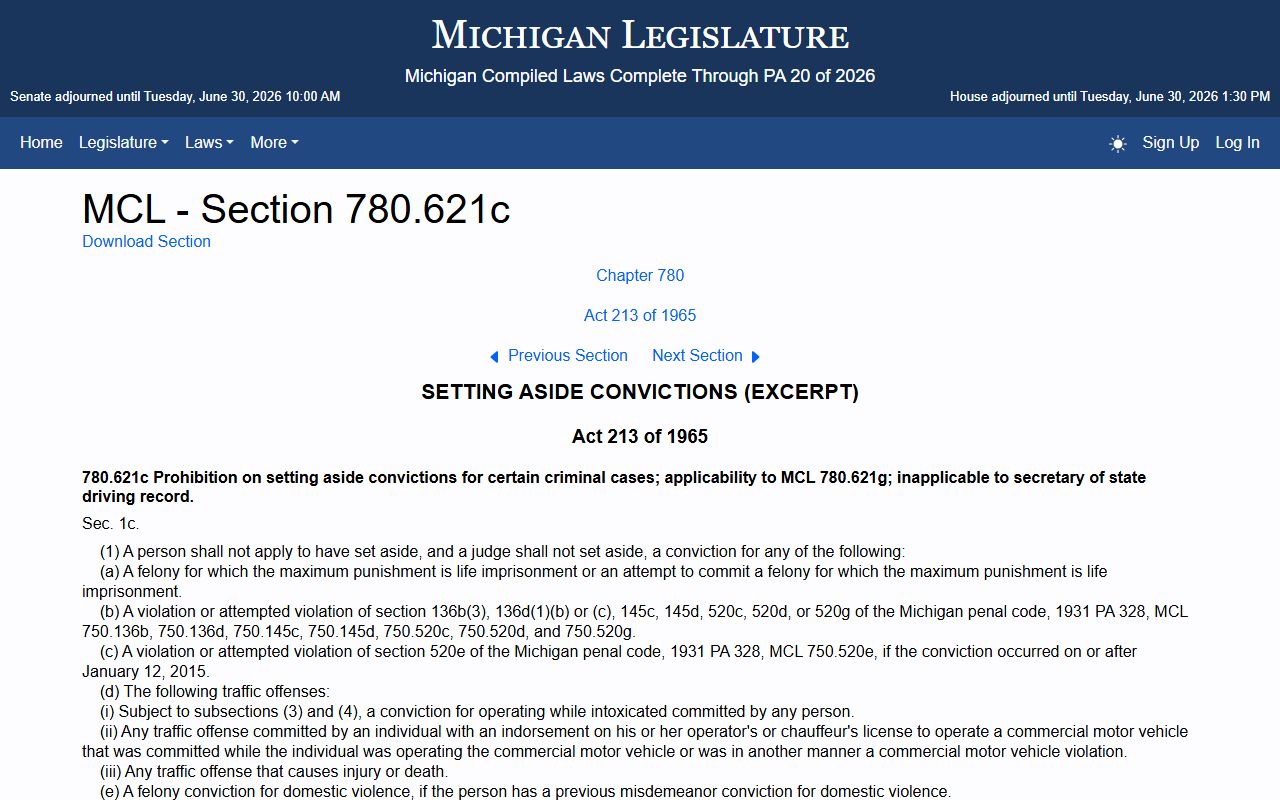
Some outcomes will not appear the way a searcher expects. Michigan's set-aside law can make eligible convictions nonpublic after waiting periods, and traffic offenses carry their own limits.
Michigan's set-aside and traffic provisions under MCL 780.621c shape what stays visible in court and criminal-history systems.
A set-aside does not erase a record from every system, so court, law-enforcement, and licensing files may still differ. Anyone trying to clear a record should gather the exact case number, charge, and sentence date before filing. For copies and certification across all three courts, the Tuscola County Clerk is the practical starting point.