
What Tuscola County Probate Court Handles
Tuscola County Probate Court is a separate statutory court, not a clerk counter. It sits inside the courthouse at 440 North State Street in Caro. The court describes its work as protecting estates and looking after people who are incapacitated or mentally ill. Judge Hon. Nancy L. Thane presides, and the office is staffed by Probate Register Janie Hemerline and Deputy Probate Register Kristi Phipps.
The court's reach is broad. It supervises the probating of wills and the administration of trusts. It hears guardianship and conservatorship cases for both adults and minors. It also handles commitment for treatment of people who are mentally ill, mentally handicapped, or addicted. As a court of statutory jurisdiction, it is primarily concerned with estates and with the protection of people who cannot look after their own affairs. Matters like marriage licenses and divorce records are handled by other offices, not by probate.
Probate work in Tuscola County covers several case types:
- Decedent estates and trust administration
- Guardianships and conservatorships for adults and minors
- Mental health treatment and hospitalization petitions
- Safe-deposit-box petitions to locate a will or burial deed
- Safekeeping of wills for living people
- Delayed registration of a foreign birth
Probate Terms Defined
Probate paperwork leans on a handful of legal words. A quick guide keeps the filings and the docket easier to read for people who are new to the process.
- Testator
- The person who made the will.
- Executor
- The person named in a will to carry out its terms and settle the estate. Michigan often calls this role the personal representative.
- Intestate
- Dying without a valid will, which means state law decides who inherits.
- Guardianship
- A probate case that gives one person the legal duty to make care and personal decisions for an adult or a minor.
- Conservatorship
- A probate case that puts one person in charge of another person's money and financial affairs.
How Probate Works in Tuscola County
A probate case moves through predictable stages, whatever the matter. Knowing the order helps a filer prepare the right paperwork and avoid a rejected petition. Each step ties back to the case type chosen at the start.
- Identify the matter type: a decedent estate, trust, guardianship, conservatorship, will deposit, safe-deposit-box petition, mental health treatment, or delayed foreign birth registration.
- Use the probate court forms menu and the Michigan SCAO forms where they apply.
- Complete every form legibly and accurately, because the court rejects petitions that do not follow the instructions.
- File at Probate Court with the correct fee and an accepted payment method.
- Expect notices, hearings, fiduciary appointments, inventories, accountings, reports, and orders based on the case type.
- Request copies from the probate court, and remember that some documents are nonpublic or limited-access.
How to Search Tuscola County Probate Records
There is no single button that opens every probate file. Start online, then move to the court office for anything the web does not show. The probate page carries a Docket link for hearing schedules, and the statewide system may list a case depending on what the court has posted.
- Open the MiCOURT Case Search and look for the case by party name or case number.
- Use the Docket link on the probate court page for hearing dates when you need a calendar rather than a full file.
- If the matter does not appear online, call Probate Court at 989-672-3850 or email tuscolaprobate@tuscolacounty.org.
Older estate files, will-safekeeping records, and mental-health matters are more reliable in person or by direct contact with the court than through a public online search. Family-division records are a separate route and are answered by the County Clerk at 989-672-3775.
Note: MiCOURT shows only what each court chooses to publish, so a missing case online does not mean the probate court has no file on it.
Tuscola County Probate Court Contact
One office handles probate scheduling and probate records questions for the county. The same phone number also covers scheduling for the family division, though family records go to the County Clerk instead.
Tuscola County Probate Court
440 North State Street
Caro, MI 48723
989-672-3850
Fax: 989-672-2057
Mon-Fri, 8:00 a.m. to 4:30 p.m.
The court publishes its staff list, forms, fees, and docket on the official Probate Court page.
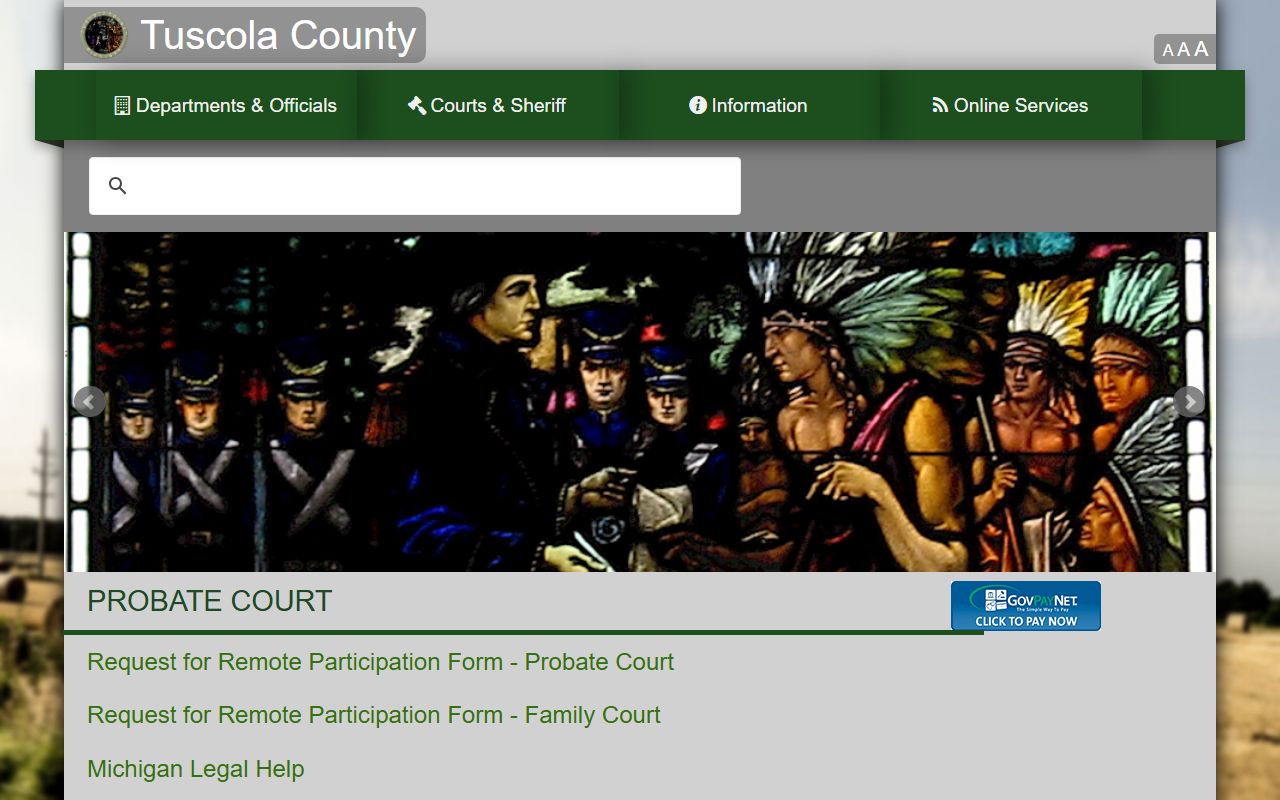
That page groups probate work into clear sections for estates, guardianships, mental health, safe-deposit boxes, and will safekeeping. The Family Division page sits alongside it and points family-division records questions back to the County Clerk.
Keep the two straight when you call. Probate scheduling and probate records use the probate number, while family-division records use the clerk's line.
Tuscola County Probate Filing Fees
The probate court posts flat fees for its most common standalone filings. The three below are the ones the court lists with set amounts. Other filings, such as opening an estate, follow the statewide schedule instead.
| Item | Amount |
|---|---|
| Petition to open a safe deposit box | $10 |
| Safekeeping of a will | $25 |
| Delayed registration of a foreign birth | $150 |
The court accepts cash, money orders, or personal checks with a driver's license and phone number. For a will deposit, bring the original will in a correctly labeled will envelope. Other filings follow the statewide Michigan Courts fee schedule that the court links from its page.
Tuscola County Probate Filing Rules
The probate court is strict about how forms come in. Court personnel cannot give legal advice and cannot complete forms, petitions, or documents for fiduciaries or interested persons. That limit comes from Public Act 386 of 1998, as amended by Public Act 52 of 1999. Forms must be typed or printed legibly and filled out fully and accurately.
The court will reject a petition that does not follow the instructions. Complete every field and use the correct form before you file, because staff cannot fix or finish it for you.
The court also carries a modern warning that few counties post. It applies to anyone drafting filings with new tools.
All attorneys and litigants must disclose the use of Artificial Intelligence (AI) and must verify the accuracies of all citations.
For a mental health petition, the court adds one more step. The petitioner must first contact a hospital to secure a bed, then complete and file the petition and pick-up order with the Clerk in Probate Court.
What Tuscola County Probate Records Show
A probate file grows as the case moves. The exact papers depend on whether the matter is an estate, a trust, a guardianship, a conservatorship, or a mental health proceeding. Most files trace the case from opening to closing.
Common documents inside a probate record include:
- Petitions and notices to interested parties
- Letters of authority naming a personal representative, guardian, or conservator
- Inventories of estate property
- Accountings and periodic reports
- Bonds, orders, and closing documents
The court's forms menu lists many of the underlying documents, including the Petition and Order to Open Safe-Deposit Box, the Safe-Deposit Box Certificate and Receipt, the Motion and Order for Delayed Registration of Foreign Birth, the Application to Establish Delayed Registration of Foreign Birth, and the Petition for Mental Health Treatment. A will held for safekeeping is stored, not filed as a public case, so it is not part of an open docket.
Estate files show how the court tracks money and property over time. An inventory lists what the estate holds. Accountings show what came in and what was paid out. Guardian and conservator reports show how a protected person is cared for and how their funds are used. Orders close each stage until the case ends.
Restricted Tuscola County Probate Records
Not every probate document is open to the public. Mental health proceedings carry medical and psychological material that statute, court rule, or a judge's order can keep confidential. Guardianship and conservatorship files that involve minors or protected persons often hold limited-access details as well.
Wills placed with the court for safekeeping are limited-access under Michigan's nonpublic records chart. They stay sealed while the maker is alive and become relevant only when an estate opens. When a record is restricted, in-person contact with the Tuscola County Probate Court is the right path, and staff will explain what a requester is allowed to see.
Fee-waiver requests and some domestic and protected-person filings are also treated as limited under Michigan court rules. A Tuscola County probate records search that turns up only a case caption, with the documents held back, usually points to one of these restrictions rather than a gap in the file.
Note: Sealed and limited-access probate files still exist even when they never appear in an online search, so ask the court directly rather than assuming a record is missing.