
Criminal Court Records in Tuscola County
A criminal court record opens the moment a charge is filed and stays with the court that handles the case. The clerk keeps every filing in one case file. That file holds the complaint, the charges, bond papers, motions, hearing notes, the plea or verdict, and the sentence. In Tuscola County, the elected County Clerk keeps circuit court criminal files, while the 71B District Court keeps its own criminal records. Each entry is dated and tied to a case number. The file grows as the case moves, so an open matter can look different from one week to the next.
Two trial courts share criminal work in the county. The 71B District Court handles misdemeanors, which are lower-level crimes, plus the early stages of felony cases. The 54th Circuit Court handles felonies once a case is sent up for trial. A misdemeanor usually stays in district court from start to finish. A felony starts in district court, then moves to circuit court after a judge finds enough proof to go forward. The Tuscola County Prosecuting Attorney files the charges in both courts.
How to Search Tuscola County Criminal Records
Most criminal case searches start online. Michigan runs a free statewide tool called MiCOURT Case Search, and it may show civil, traffic, criminal, and other case types depending on the court. The 71B District Court also posts a daily public docket display. Neither tool replaces the full paper file, but both point a searcher to the right case number and the right court.
- Open MiCOURT Case Search and pick the Tuscola County court that holds the case.
- Search by the defendant's last name, or enter the case number if it is known.
- Narrow the results by court, case type, and filing date.
- Open the matching case to read the charge list, docket events, and disposition.
- Ask the County Clerk or the district court for a certified copy when a signed record is needed.
Court records and criminal history are not the same thing. MiCOURT shows individual court cases. The Michigan State Police keeps a separate statewide criminal history check. When an online search comes up empty, the fastest fix is a call to the court that owns the file, because older or non-digitized records may never appear online.
Stages of a Tuscola County Criminal Case
A criminal case moves through set stages, and each one leaves a mark in the record. A felony and a misdemeanor share many of the same steps, but felonies add a screening phase in district court before they reach circuit court. Reading the docket in order shows exactly where a case stands and what comes next.
Felony case flow: Charges Filed › Arraignment › Probable-Cause Conference › Preliminary Exam / Bindover › Circuit Arraignment › Plea or Trial › Disposition › Sentencing
- Arraignment
- The charges are read, rights are explained, and the judge may set bond and future dates.
- Probable-Cause Conference
- An early district court hearing where the parties discuss the case and any resolution before the exam.
- Preliminary Exam / Bindover
- A district judge decides whether enough proof exists to send a felony up to circuit court.
- Circuit Arraignment
- The defendant answers the information, which is the formal felony charge filed in circuit court.
- Plea or Trial
- The defendant pleads, or a judge or jury decides guilt.
- Sentencing
- The court imposes the penalty after a plea or a guilty verdict.
Misdemeanors skip the exam and bindover steps. They stay in the 71B District Court through plea, trial, sentencing, probation, and any collections.
What Tuscola County Criminal Records Show
The value of a criminal file is in its detail. Each field answers a different question about the case. The table below lists the main fields a Tuscola County researcher should expect to find in a criminal court record.
| Field | What It Shows |
|---|---|
| Case Number | The unique ID assigned by the court; the format varies by circuit or district court. |
| CTN | The criminal tracking number tied to a criminal matter, shown on the district docket display. |
| Defendant | The person accused; the prosecutor appears as the opposing party for the People. |
| Charges | The offenses filed, with the statute cited and the level marked as felony or misdemeanor. |
| Plea | The defendant's answer, such as guilty, not guilty, or no contest. |
| Disposition | The outcome of each charge, such as convicted, dismissed, or acquitted. |
| Sentence | The penalty imposed, which can include jail, probation, fines, costs, or restitution. |
Financial lines track fines, costs, and restitution. Redaction rules matter too. District court filings cannot list a birth date, Social Security number, driver license number, or financial account number.
Reading Dispositions and Sentences
Disposition is the court's word for how a charge ended. Common entries include guilty, not guilty, and dismissed. No contest is a plea that accepts the penalty without admitting fault. A deferred or delayed sentence may let a defendant avoid a conviction after meeting set conditions. The sentence follows the disposition.
A sentence can combine several parts. Jail or prison time, probation, fines, court costs, and restitution to a victim may all appear. Probation means supervision in place of, or after, custody. When a case shows a plea to a lesser offense, the record notes both the original charge and the reduced one, so the full path stays visible.
Charges vs. Convictions
Being charged is not the same as being convicted. A charge is only an accusation. A conviction is a finding of guilt by plea or verdict. A criminal file often lists charges that were later dropped, dismissed, reduced, or ended in acquittal. Reading only the top charge can badly mislead. The disposition line is where the real outcome lives.
| Charge | Conviction | |
|---|---|---|
| Stage | Accusation | Verdict or plea |
| Burden of Proof | Probable cause | Beyond a reasonable doubt |
| Public Record | Yes | Yes |
Note: A dropped or dismissed charge still shows in the case file unless a court later sets the record aside under state law.
Tuscola County Prosecutor's Role
The Tuscola County Prosecuting Attorney drives the charging decision. Police send reports to the office, and the prosecutor reviews them and decides which charges to authorize and file. Erica Walle serves as the current Prosecuting Attorney. The office appears at arraignments, preliminary exams, trials, and sentencings, and it handles victim-rights contact throughout a case.
The office publishes its staff and contact details on the Tuscola County Prosecuting Attorney page.
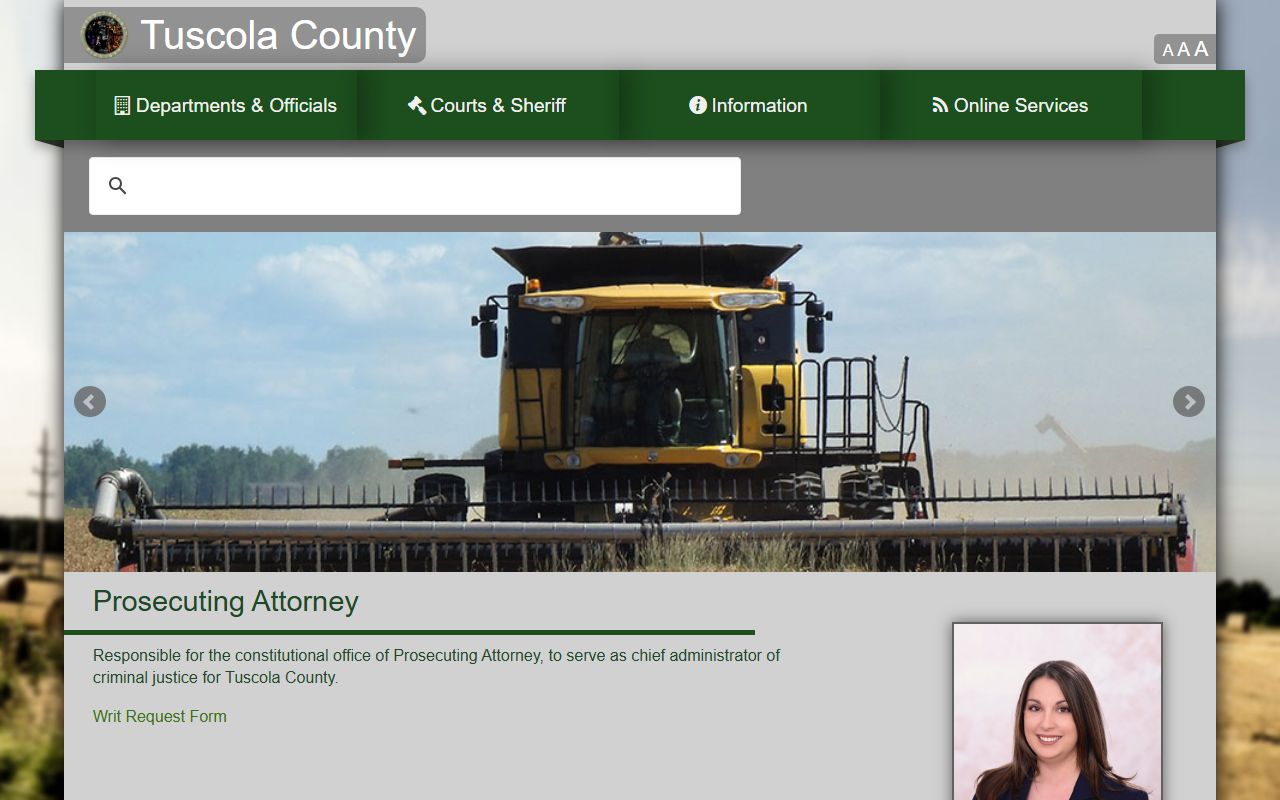
Because the prosecutor decides the charges, the office is often the clearest source for why a specific count was filed, amended, or dropped. A charge can be added, reduced, or withdrawn based on the office's review of the proof.
Tuscola Records vs. Criminal History
A court file and a statewide criminal history serve different needs. MiCOURT shows one court's cases. The Michigan State Police runs ICHAT, the Internet Criminal History Access Tool, which pulls a person's statewide record into one report. ICHAT is name based and charges a fee for each search.
The state explains coverage and limits on the Michigan State Police criminal history page.
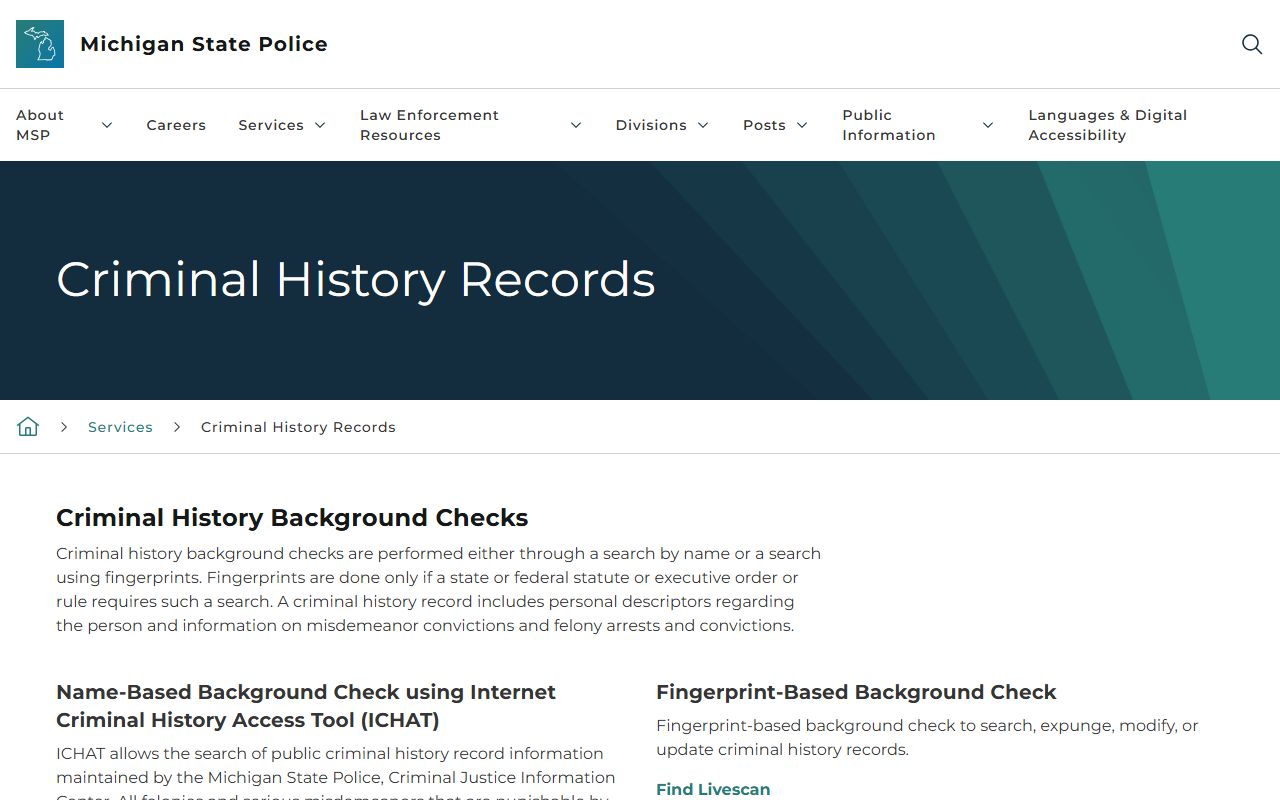
ICHAT leaves out several record types, so it should never be treated as a full picture of a person's court history. ICHAT does not include:
- Warrant information.
- Traffic records.
- Juvenile records.
- Local misdemeanors held only at the district level.
- Federal and tribal court records.
- Suppressed or sealed records.
For any of those, the court that holds the file remains the better source.
Sealed vs. Set-Aside Records
Michigan does not use the word expunge in its statutes. It uses set aside. A set-aside makes an eligible conviction nonpublic, so it no longer shows on most background checks. The state's Clean Slate law expanded this in two ways. Some convictions now clear on their own after a waiting period, while others still need an application.
| Sealed | Set Aside | |
|---|---|---|
| Visibility | Case hidden from public view by court order | Conviction removed from public criminal history |
| How It Happens | A judge seals a file or a specific document | An application or the automatic Clean Slate process |
| Eligibility | Narrow, set by court rule or statute | Set by MCL 780.621 and Clean Slate limits |
The set-aside process runs through MCL 780.621, the state's set-aside statute.
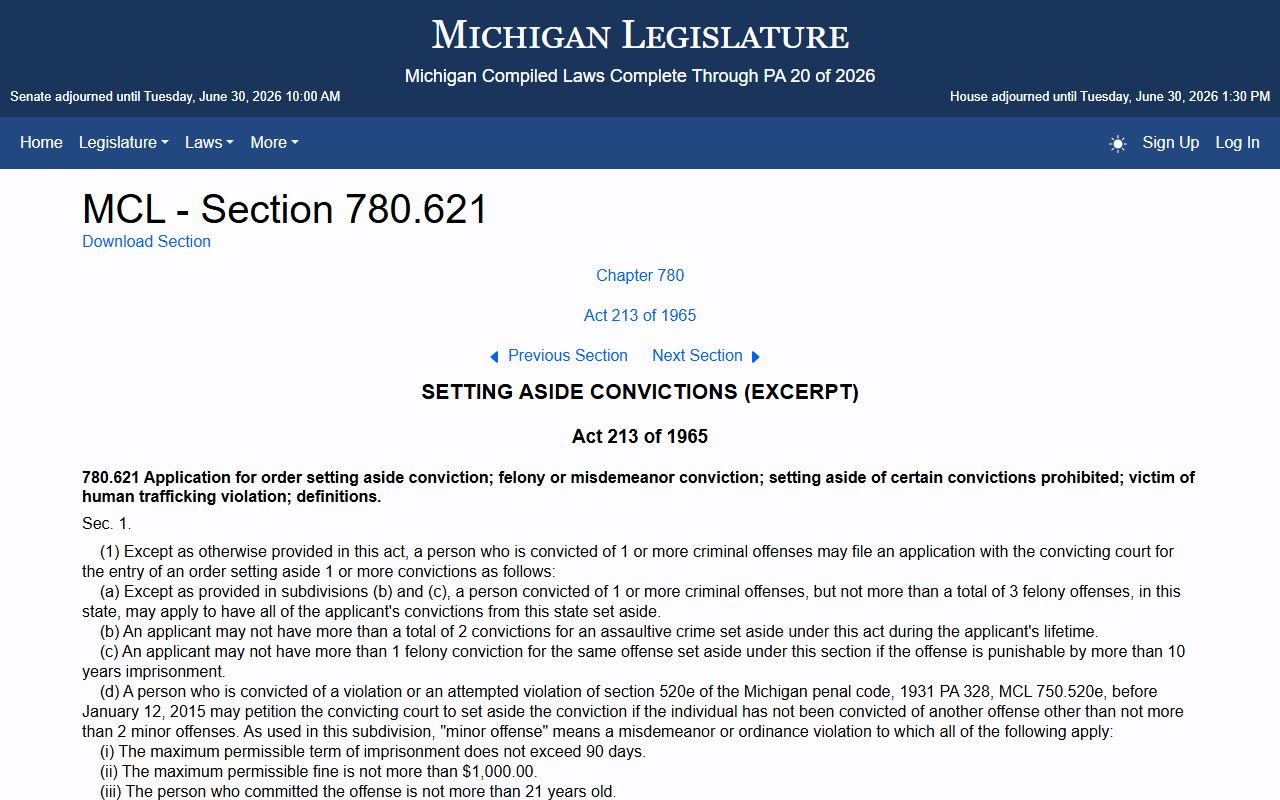
A set-aside does not erase every trace. Law enforcement and some agencies may still see the record for limited purposes. Traffic offenses follow special limits, and juvenile cases use separate rules. Collecting the exact case number, charge, and sentence date first makes any set-aside request smoother.
Access to Tuscola County Criminal Records
Michigan treats court records as open by default. Access runs on court rules and statutes, not on a single database. The Michigan Court Rules set how clerks keep files and who may see them. The Freedom of Information Act covers many other public-body records, such as sheriff reports, though court files themselves follow court rules first.
Key Statutes:
MCL 15.231 - Michigan's FOIA policy that people are entitled to information about their government.
MCR 8.119 - the court rule that governs how trial courts keep and share case records.
Open access has limits. Some documents inside a public file are still restricted, and whole categories of cases stay closed.
Restricted Tuscola County Criminal Records
Some criminal records stay out of public view. Juvenile cases are the clearest example. Under MCL 712A.28, juvenile court records are open only by court order, and the county routes juvenile records through a separate office. Sealed and set-aside cases also drop out of public search once a court acts.
Other limits apply case by case. A sealed document, a confidential victim address, or an active investigation may be withheld even inside an otherwise public file. Charges filed after arrest and their status are covered on the arrest records and court charges page, and every court file type is covered on the Tuscola County court records page.
Background Check Considerations
Employers, landlords, and licensing boards often want a formal background check. Those reports follow the federal Fair Credit Reporting Act and must come from a regulated screening company. A casual name search on a court portal is fine for personal knowledge, but it does not meet FCRA rules.
Important: This site is not a consumer reporting agency under the FCRA, and its information cannot be used for credit, employment, tenant, insurance, or other regulated decisions.