
Tuscola County Inmate Search Options
Tuscola County does not publish an online searchable jail roster. The Sheriff's Office website offers a jail information link and a visitation page, but it does not expose a public tool that lists current inmates by name. That gap changes how a search works here. Instead of typing a name into one county database, you move through a short chain of official channels, starting with a phone call and moving out to statewide systems and records requests.
The most direct answer comes from the jail itself. Sheriff's staff can confirm whether a person is in custody, when they were booked, and what the next step looks like. Statewide tools then fill specific roles. Michigan VINE tracks custody status and sends notifications, while the state corrections search covers prisoners under state jurisdiction. None of these replace the county jail as the source of truth for someone held locally right now. Custody and court records are two different files, so a full picture often means checking the sheriff for custody and the courts for the case. The sections below walk each channel one at a time.
Call the Tuscola County Jail
Since there is no county roster online, the fastest way to confirm custody is a direct call to the Sheriff's Office. Staff can tell you whether a named person is currently held, when the booking happened, and how bond and release are handled. Have the full legal name and, if possible, a date of birth ready before you call, because common names slow the search.
The Sheriff's report and records page explains how the office handles copies of reports and public-records questions. The Sheriff's Office details page outlines report-copy contacts and lobby access instructions for visitors.
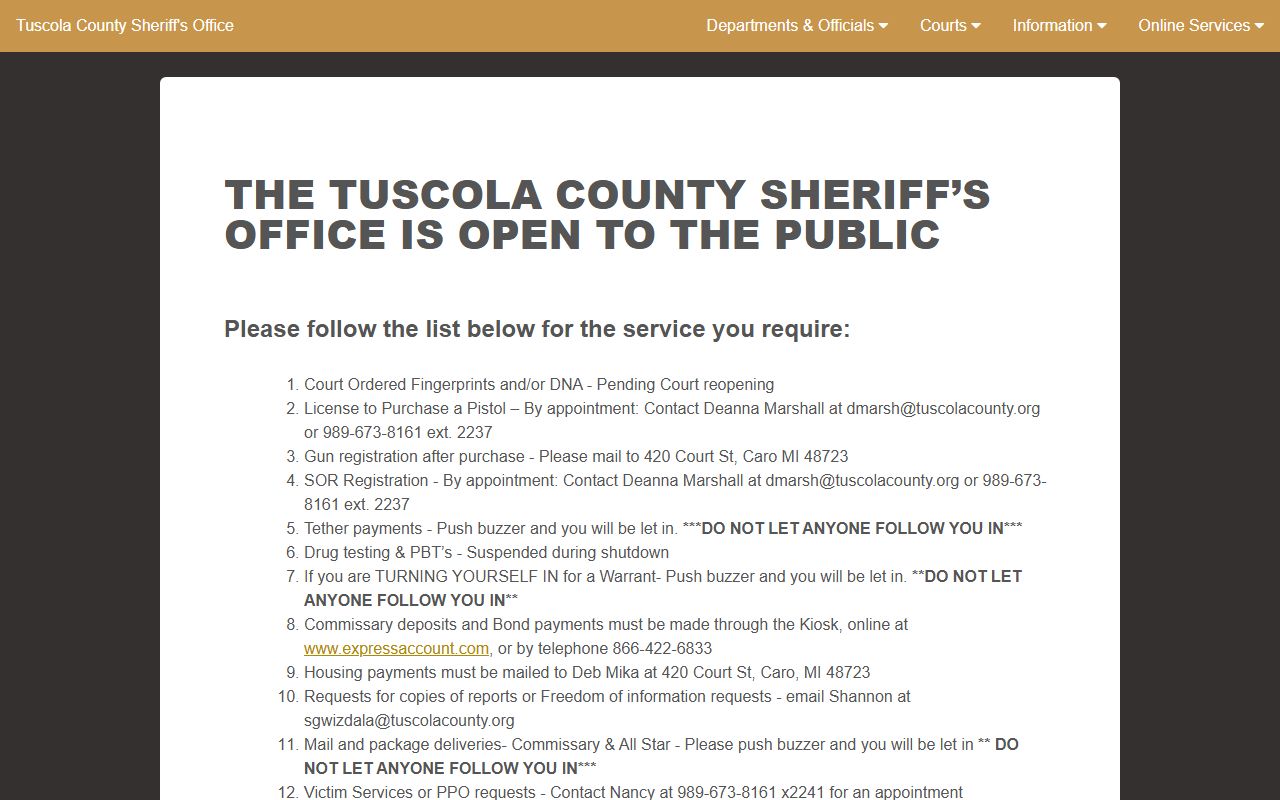
That same office is the one to ask about booking details that never appear online. Bond amount, housing assignment, and expected release timing may be available by phone or through a public-records request, so a call is often faster than any website.
Track Custody With Michigan VINE
Michigan VINE is a free statewide service that reports custody status and sends automatic notifications when that status changes. Victims, families, and anyone with a safety concern can register for alerts about release, transfer, or escape at participating agencies. VINE does not replace a call to the jail, but it is useful for ongoing monitoring rather than a one-time check.
You can reach the service and register for alerts through the Michigan VINE portal. The site lets you look up a person and choose how you want to be notified, by phone, email, or text.
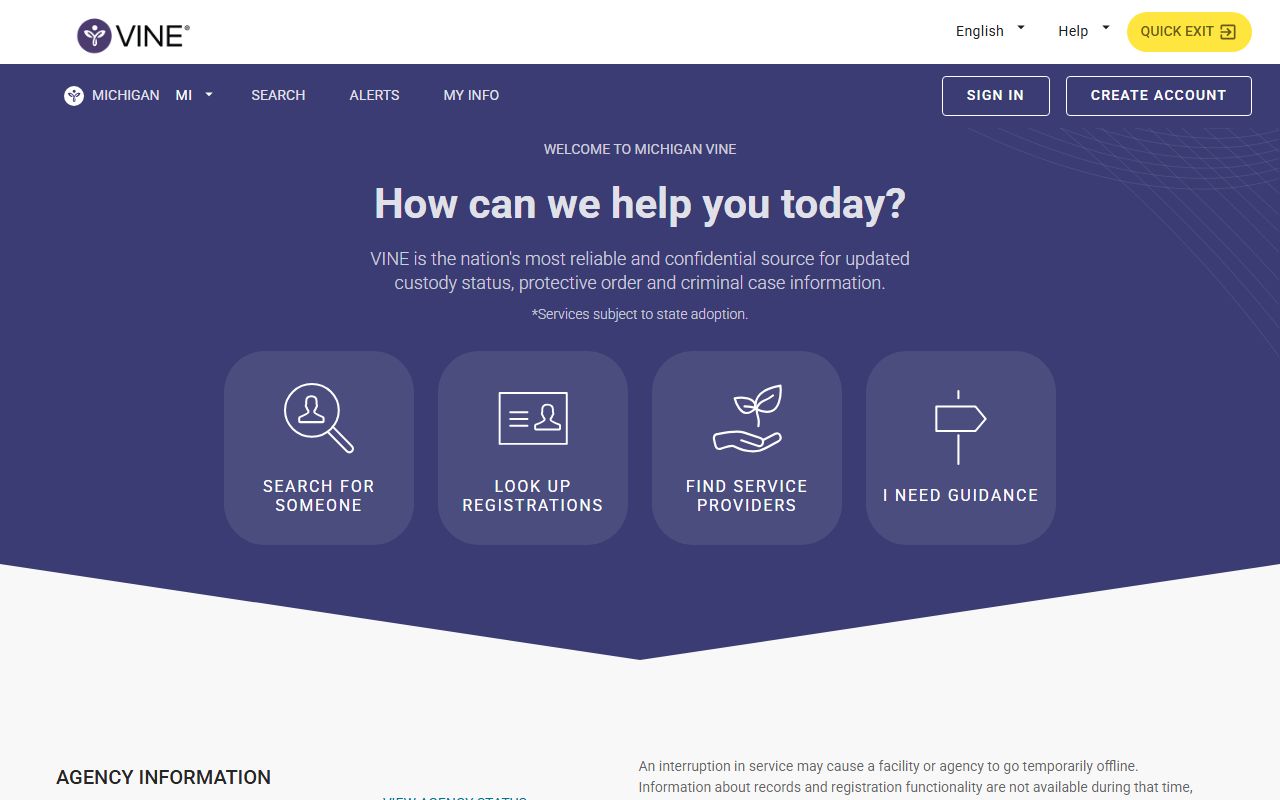
Coverage depends on which agencies feed data into the system, so results can lag behind a live booking. Treat a VINE alert as a helpful signal, then confirm anything urgent with the Sheriff's Office directly. For victims who need reliable warning before a release, registering early gives the most benefit.
Note: VINE tracks status and notifications and is not a substitute for confirming current local custody with the jail by phone.
OTIS Covers State Prisoners, Not County Jail
The Michigan Department of Corrections runs the Offender Tracking Information System, known as OTIS. It is a free statewide search, but its coverage is narrow in a way that matters for county searches. OTIS lists prisoners, parolees, and probationers under state supervision or discharged within the last three years. It does not cover people held in the local jail.
The state's own description of the system spells out those limits clearly. According to the MDOC OTIS overview, the database does not include FOIA-exempt information, persons arrested and convicted but not yet sentenced, prisoners in county jails or city lockups, offenders sentenced to jail only, older missing photos, or offenders off supervision for more than three years.
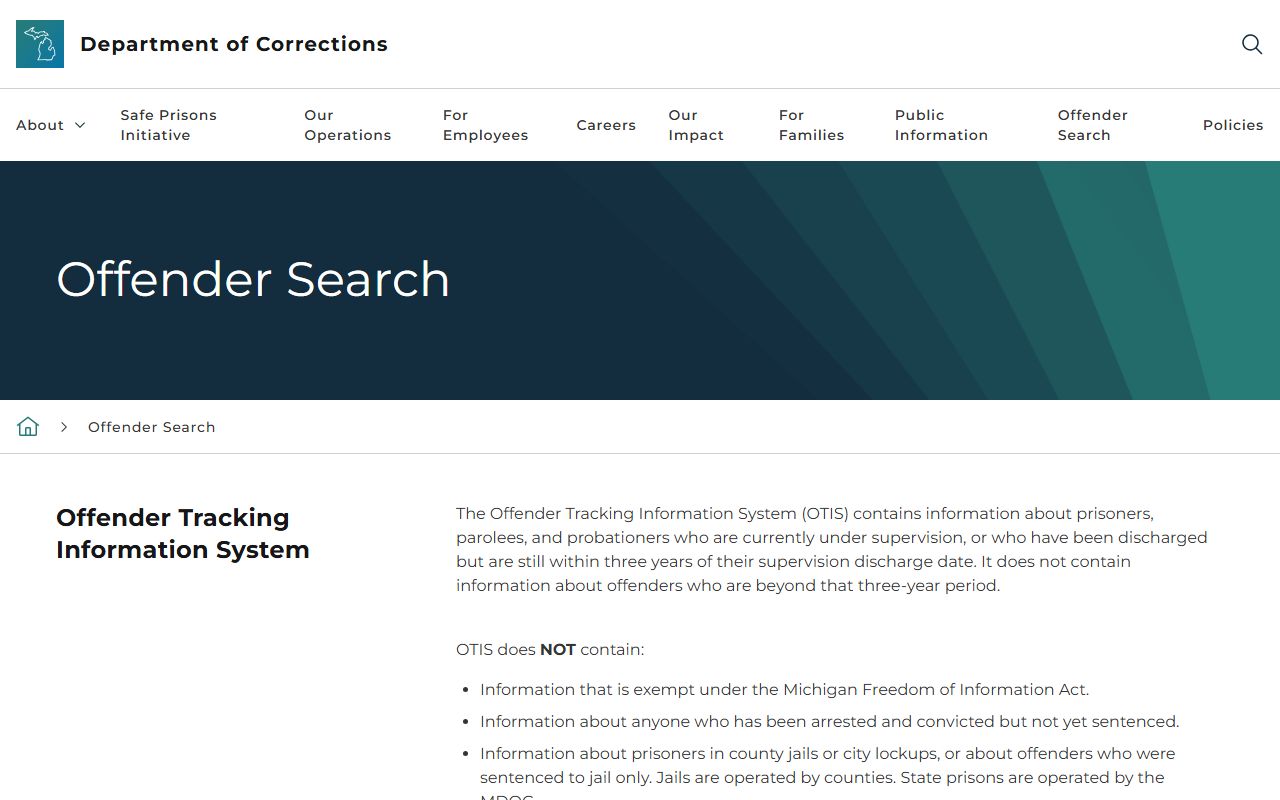
The practical takeaway is simple. Someone arrested today and booked into the Tuscola County Jail will not appear in OTIS unless a court later sentences that person into state custody. OTIS is the right tool for state prisoners and people on parole or probation, and the wrong tool for a fresh county booking.
OTIS Inmate Search Fields
When a search does belong in OTIS, the form accepts several inputs. You can search by name alone or add filters to narrow a common name. None of the fields are strictly required, so you can start broad and tighten the search as needed. The offender number returns the most exact match when you already know it.
| Field Label | Type | Required | Notes |
|---|---|---|---|
| Last Name | Text | No | Search by offender last name. |
| First Name | Text | No | Narrows a name search. |
| Offender Number | Text | No | MDOC number if known; most exact match. |
| Sex | Dropdown | No | Either, Male, or Female. |
| Race | Dropdown | No | All, or a specific race category. |
| Age | Number | No | Search by age. |
You can open the search directly at the OTIS offender search form. Enter what you know, review the list of matches, then open a profile to confirm identity by photo, age, and status.
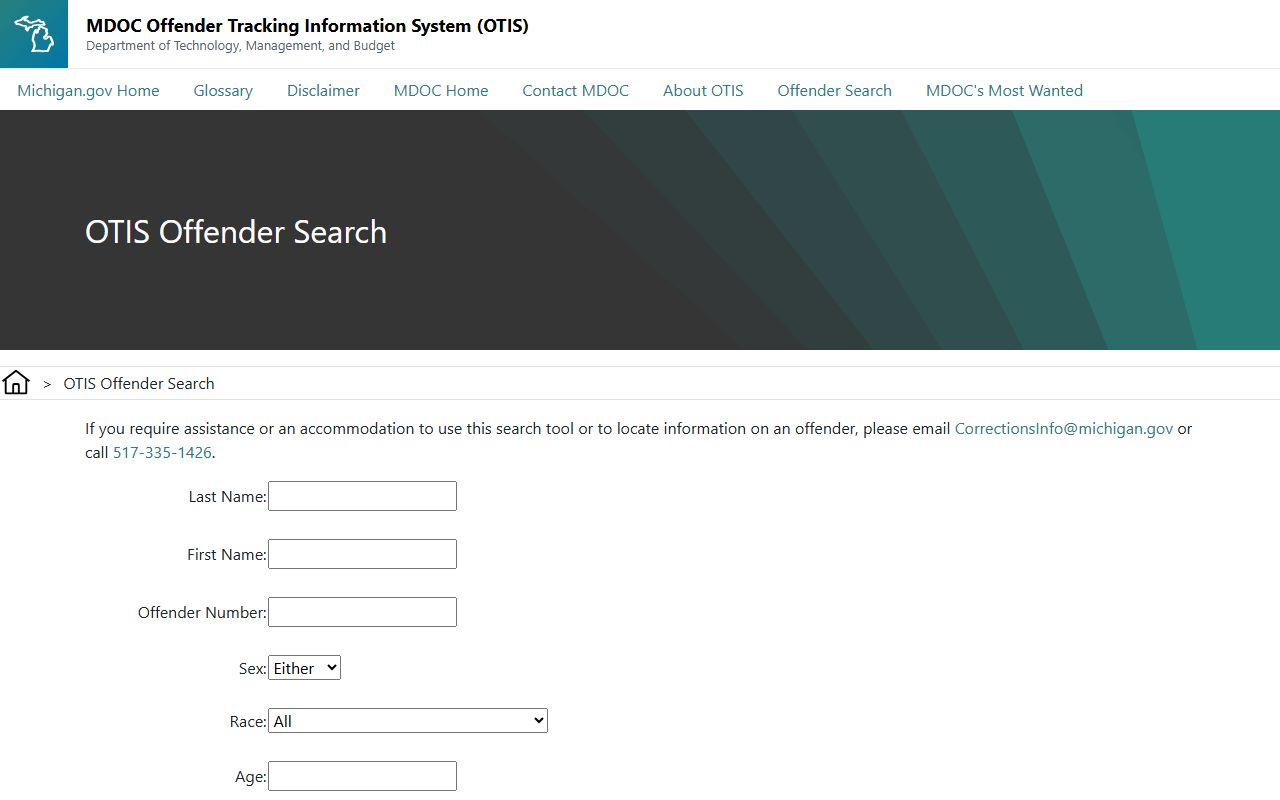
Because OTIS covers the whole state, a broad name search can return people from many counties. Read each result carefully and match on more than the name before you rely on it.
Inmate Details That May Be Available
No official Tuscola County online inmate profile was available to inspect, so this page does not claim a website that shows mugshots, booking numbers, charges, or bond. The fields below describe the kinds of custody details that may be available by calling the jail or through a public-records request when the information is public. Treat the list as a checklist for what to ask about, not a screen you will find online.
| Field | What It Shows |
|---|---|
| Booking Number | The intake identifier the jail assigns at booking; useful for follow-up requests. |
| Booking Date | When the person was taken into custody at the jail. |
| Charges | The offenses tied to the arrest; the formal charges live in the court case file. |
| Bond Amount | The dollar figure or condition set for release, when one has been set. |
| Housing Unit | Where the person is held inside the facility, which can affect visitation. |
| Projected Release | An expected release date or the event that ends custody, such as bond or a hearing. |
Charges and bond conditions are court records rather than jail records. To track those, the arrest-to-charge path runs through the county arrest and court charge records, and the full case file sits in the court system. Ask the jail for custody facts and the courts for the charging document.
How to Confirm Someone Is in Custody
With no single roster to search, a short, ordered process works best. Start local, then widen out only if the local answer points elsewhere. The steps below move from the fastest confirmation to the statewide tools and finally to written records.
- Call the Sheriff's Office and ask whether the named person is currently held; give a full name and date of birth.
- Register on Michigan VINE to receive alerts if custody status changes.
- Search OTIS only if the person may be a state prisoner, parolee, or probationer rather than a local jail inmate.
- Search the state court system for the related case to find charges, bond, and hearing dates.
- File a Sheriff's records request for booking or report copies that are public but not posted online.
Working the steps in order avoids wasted effort. A quick call often ends the search at step one, and the later steps exist mainly when the case has moved beyond local custody or when you need documents in writing.
Request Booking and Report Records
When you need copies of booking information, incident reports, or other jail records, the Sheriff's Office handles those through a public-records request. Michigan's open-records law gives the office a set window to respond and allows a fee, and the office can send a fee estimate before it does the work. Requests can be delivered in person to the Sheriff's Office or emailed to the office contact listed on the request form.
Michigan's Freedom of Information Act sets the ground rules for what the office must release and how quickly. State guidance on the process is published through the Michigan Attorney General FOIA resources, which explains response times, fees, and how to appeal a denial.
Booking and custody records are the sheriff's to release, while charges and case outcomes belong to the courts. If your request is really about the criminal case, the court file will serve you better. For a statewide criminal-history check on a person, Michigan State Police runs a separate service described below.
Criminal History Through MSP ICHAT
For a broader look at a person's record, the Michigan State Police Internet Criminal History Access Tool, called ICHAT, offers a statewide name-based search of public criminal-history records. It is a paid search and returns conviction information from contributing Michigan agencies. ICHAT is not a jail roster and will not tell you whether someone is in custody right now.
The tool has real limits worth knowing before you pay. ICHAT excludes warrants, traffic offenses, juvenile records, federal and tribal records, many local misdemeanors, and records that have been suppressed. Because of those gaps, an ICHAT search complements rather than replaces a court-case search for a specific matter.
Booking Process in Tuscola County
After an arrest by the sheriff, a local police department, or another agency, a person may be transported to the Tuscola County Jail. Jail staff then create the booking and intake records that start the custody file. They secure personal property, screen the person for medical and security needs, and assign a classification that guides where the person is housed inside the facility.
Custody continues until one of a few things happens. The person may post bond, be released, be arraigned, be transferred, or be held under a court order. The District Court is the usual first court for misdemeanors and for the early stages of a felony. Bond conditions, court dates, and formal charges are set by the court, so those details are court records even when they follow directly from the booking. Because statewide systems can lag or may not cover local jail custody at all, current status should always be confirmed with the jail rather than assumed from an online search.
Tuscola County Sheriff's Office
The Sheriff's Office is the corrections agency for county jail custody and the first stop for custody, booking, bond, visitation, and release questions. Sheriff Ryan Robinson leads the office. His official biography notes a criminal justice degree from Saginaw Valley State University, police academy training at Delta College, and a career at the office that began in 2006 as a corrections deputy before moving to road patrol and a supervisory role.
The contact details below cover the main lines. Emergencies should always go to 911, while the non-emergency dispatch line handles routine calls. Lobby hours differ across county pages, so confirm current hours by calling or checking the Sheriff's page before you visit.
Tuscola County Sheriff's Office and Jail
420 Court Street
Caro, MI 48723
Main: 989-673-8161
Fax: 989-673-8164
Non-emergency dispatch: 989-673-8738
Lobby hours vary by source; call to confirm.
Keep the main line handy for custody and booking questions and the dispatch line for non-emergency reports. For records copies, ask which contact handles report and FOIA requests so your paperwork reaches the right desk.
Tuscola County Jail Visitation
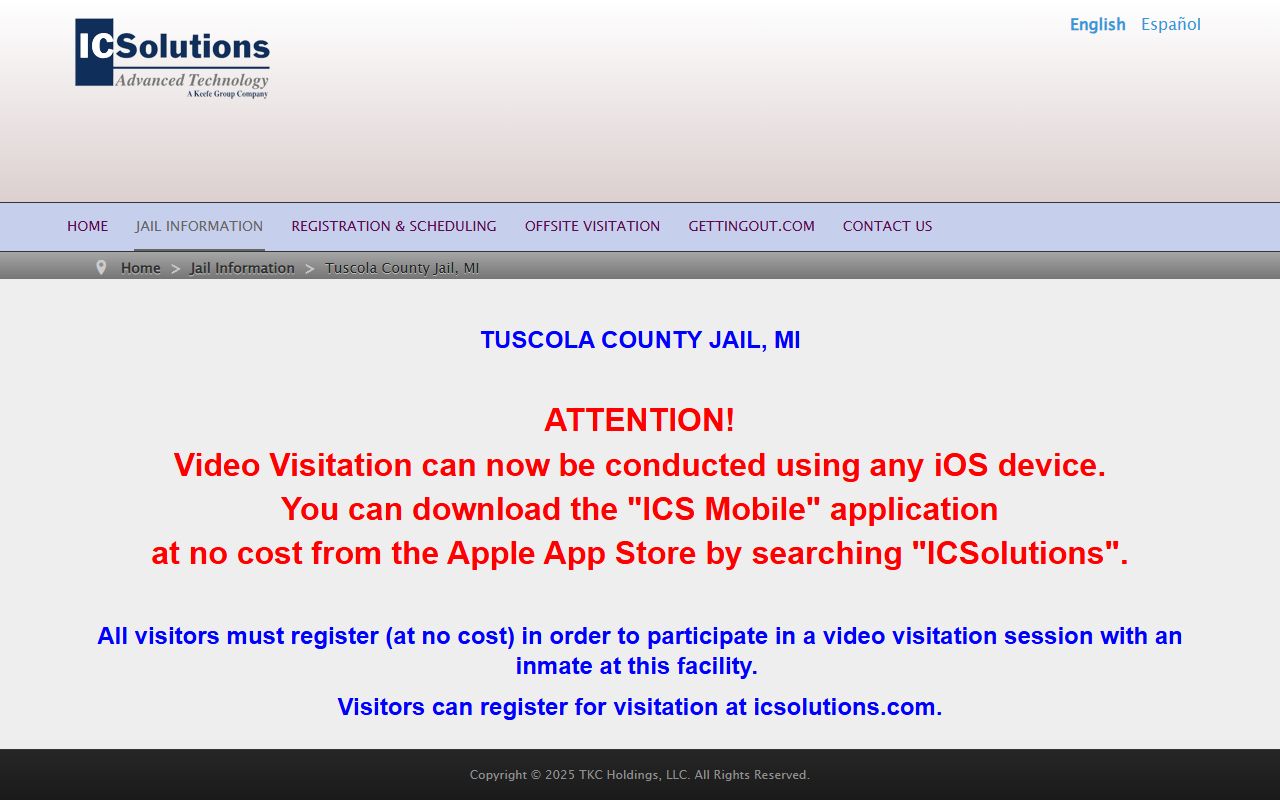
The jail moved to video visitation on March 2, 2021, and it uses the ICSolutions system, branded as The Visitor. Onsite visits remain free under normal business operations, and every visitor must complete a free one-time registration before scheduling a first visit. Registration can be done through the ICSolutions website or at the kiosk in the jail lobby, where the visitor video terminals are located. Each inmate is allowed one onsite video visit per week.
Details for the local facility, including registration and device options, are published on the ICSolutions Tuscola County Jail page. Offsite visits are fee-based and can run from a Windows computer, an Android device, or an iPhone or iPad.
| Visit Type | Where | Cost | Notes |
|---|---|---|---|
| Onsite video | Terminals in the jail lobby | Free | One onsite visit per inmate per week; register first. |
| Offsite video | Windows computer | Fee-based | Download and test the app before scheduling. |
| iOS mobile | iPhone or iPad | Fee-based | Download "ICS Mobile" from the Apple App Store. |
| Android mobile | Android device | Fee-based | Download the app via the Google Play link. |
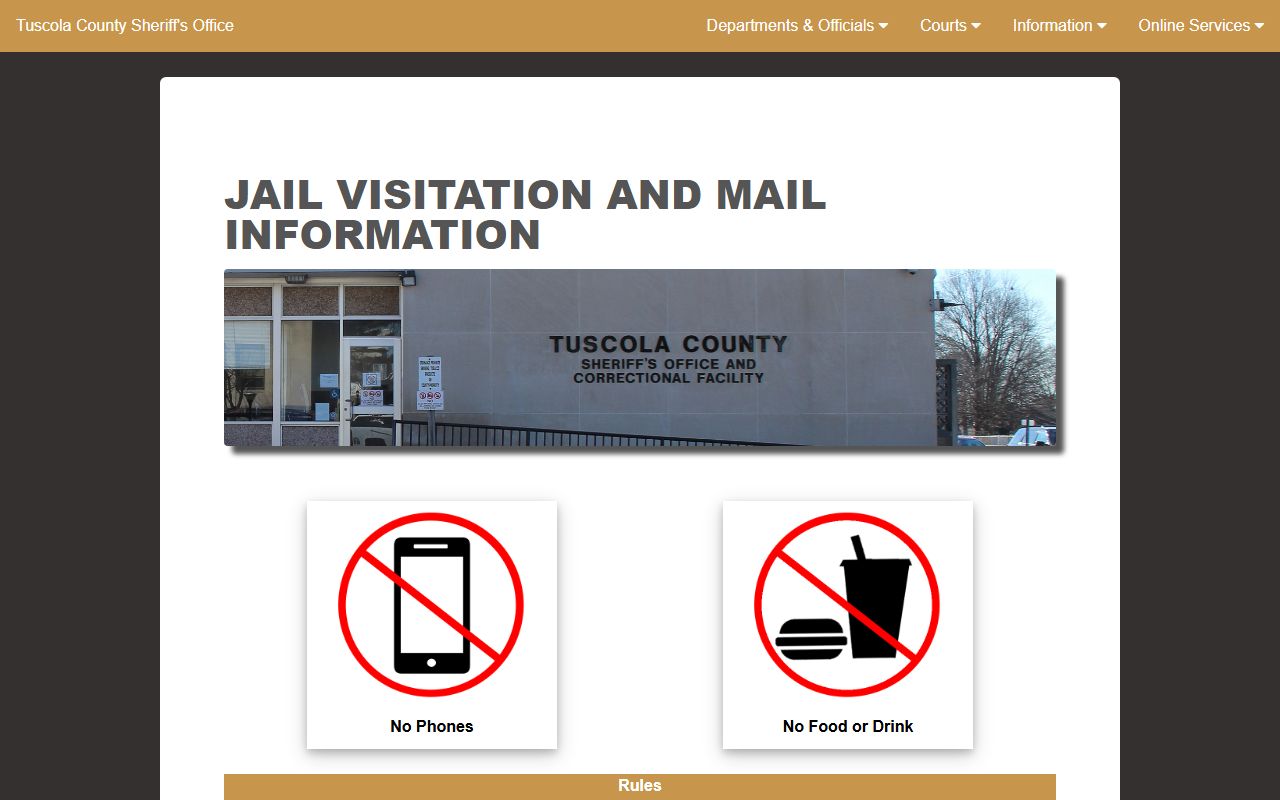
The official visitation and mail page is worth a look before any visit. The Sheriff's jail visitation page posts clear signage, including "No Phones" and "No Food or Drink," in the visitation area.
Offsite visitors should download and test the app on their device before scheduling, since connectivity problems during a paid offsite visit are not refunded. The ICS Mobile app is for visitation only and does not perform any inmate lookup. Attorneys and other professionals should contact the jail or court directly about professional visitation rather than relying on the family and friends schedule.
Note: Onsite registration and the free weekly onsite visit are the lowest-cost way to see an inmate, so set up an account early.
Inmate Mail and Commissary
Official Tuscola County pages do not publish a complete mail address format, a banned-items list, a commissary fee table, or phone-call rates. The Sheriff's details page references mail, package, and commissary deliveries with lobby buzzer instructions, but it does not lay out a full mail-handling or commissary policy that can be reproduced here. Rather than guess at rules that could be wrong, treat these as questions for the jail.
Call the Sheriff's Office to confirm the current mailing address, what items are allowed, how to add money for an inmate, and the current phone or messaging rates. The ICSolutions account portal lets visitors add funds, but the county text does not confirm whether those funds are for visitation only or for a commissary trust account, so ask before you send money.