
Warrant Records in Tuscola County
A warrant is a court order. It authorizes police to arrest a person, search a place, or bring someone before a judge. In Tuscola County, warrants are signed by a judge or a magistrate after a finding of probable cause. Some start with a criminal complaint. Others come from the bench when a person misses a court date or breaks a court order.
The Prosecuting Attorney also plays a role. That office reviews police reports and authorizes charges before many arrest warrants issue. Prosecutor Erica Walle leads the office, which appears at arraignments and preliminary examinations across the local courts. Charge decisions and warrant activity are closely linked in the criminal process.
No official Tuscola County website publishes a searchable list of active warrants. There is no county warrant portal and no most-wanted database in the reviewed county sources. That gap changes the search strategy. Instead of typing a name into one site, a person must reach the office or court that holds the record. The channels below cover every documented way to confirm a Tuscola County warrant.
How to Check for a Tuscola County Warrant
Start with the agency most likely to hold the record. The Tuscola County Sheriff's Office is the county's law enforcement and corrections agency, and it can answer warrant-related questions by phone. The main line is 989-673-8161. Central dispatch handles non-emergency calls at 989-673-8738, and true emergencies go to 911.
Court warrants track back to the court that issued them. Missed misdemeanor, traffic, or preliminary-exam dates usually produce a bench warrant from the 71B District Court. The court's magistrate office at 989-672-3790 can confirm amounts due and hearing requirements on many traffic and lower-court matters. Felony warrants and probation-violation warrants after bindover or sentencing tend to route through the 54th Circuit Court.
The Sheriff's Office publishes crime tips, payment links, and public-records routing that help point a caller to the right desk.
The Tuscola County Sheriff's Office page shows the office phone, lobby hours, and jail and records links used for warrant questions.
The Sheriff's Office homepage is a useful first stop for contact details and records routing.
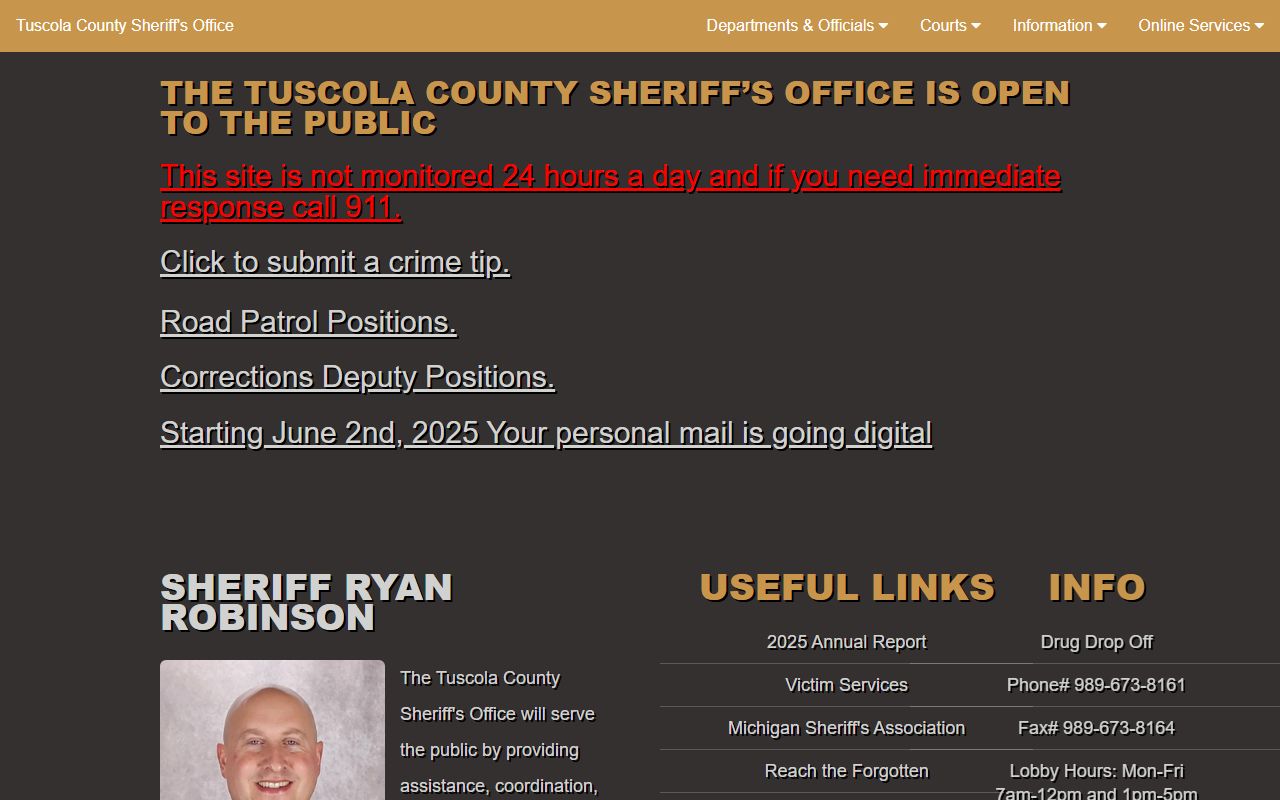
The page confirms the phone lines and lobby access a person needs before asking about a possible Tuscola County warrant. For a full sequence, work through these steps.
- Call the Sheriff's Office at 989-673-8161, or use dispatch at 989-673-8738, and ask how warrant questions are handled.
- Identify the court. Traffic and misdemeanor holds start in 71B District Court; felony and probation holds are usually in the 54th Circuit Court.
- Call the district magistrate at 989-672-3790 for traffic or lower-court matters, or the circuit records clerk at 989-672-3775 for felony files.
- Search MiCOURT Case Search for any related open case, then confirm warrant status directly with the office.
Note: Active warrant status is often confirmed only by law enforcement or the court, so a phone call usually beats any online lookup for current information.
Using MiCOURT for Related Cases
MiCOURT Case Search is the statewide public case-search system for Michigan courts. It can show civil, traffic, criminal, domestic, and probate cases, depending on the court. A researcher can look up a party name or case number to see whether a criminal matter is open in Tuscola County. That case may be the one tied to a warrant.
The 71B District Court also runs a public Court Display for daily dockets. It lists party name, hearing time, hearing information, case number, and the criminal tracking number, known as the CTN. A hearing entry can hint at an active matter, though the warrant itself may not appear. MiCOURT is best treated as a lead, not as final proof of warrant status.
Why ICHAT Is Not a Warrant Search
Many people assume a criminal-history check will reveal a warrant. It will not. The Michigan State Police ICHAT service runs name-based criminal-history searches, but it excludes several record types by design. Warrant information is one of them.
ICHAT also leaves out traffic records, juvenile records, local misdemeanors, federal records, tribal records, and suppressed records. So a clean ICHAT report does not mean a person is free of a warrant. For warrant status, the Sheriff's Office and the issuing court remain the correct sources, not a statewide history search.
Types of Warrants in Tuscola County
Warrants are not all the same. The label affects who issued the order, why it exists, and how a person answers it. Several kinds show up in Tuscola County court and sheriff records.
- Arrest warrant - issued when a court finds probable cause to arrest a person on a criminal complaint.
- Bench warrant - issued from the bench for a failure to appear, a failure to comply, contempt, or an unpaid obligation where the law allows.
- Search warrant - authorizes law enforcement to search a place, person, or property, and it is often sealed during an active investigation.
- Probation violation warrant - may issue after an alleged violation of district or circuit court probation.
- Civil or family enforcement warrant - can arise from contempt or Friend of the Court enforcement, though details may be restricted.
- Fugitive or out-of-county warrant - involves another county or state, so custody and extradition depend on the issuing jurisdiction.
Note: A bench warrant for a missed court date can be cleared through the issuing court, while a felony arrest warrant usually calls for defense counsel first.
Requesting Tuscola County Warrant Records
Some warrant and incident details are public records held by the Sheriff's Office rather than the courts. Those are requested through the Sheriff's Freedom of Information Act form. The form asks for the subject's name, date of birth and address if known, and incident details such as dates and an incident number. A signature and the requester's contact information complete it.
Michigan's Freedom of Information Act sets the framework for these requests, and the state offers plain-language guidance on how the law works.
The Michigan Attorney General FOIA page explains public-body records access in plain terms.
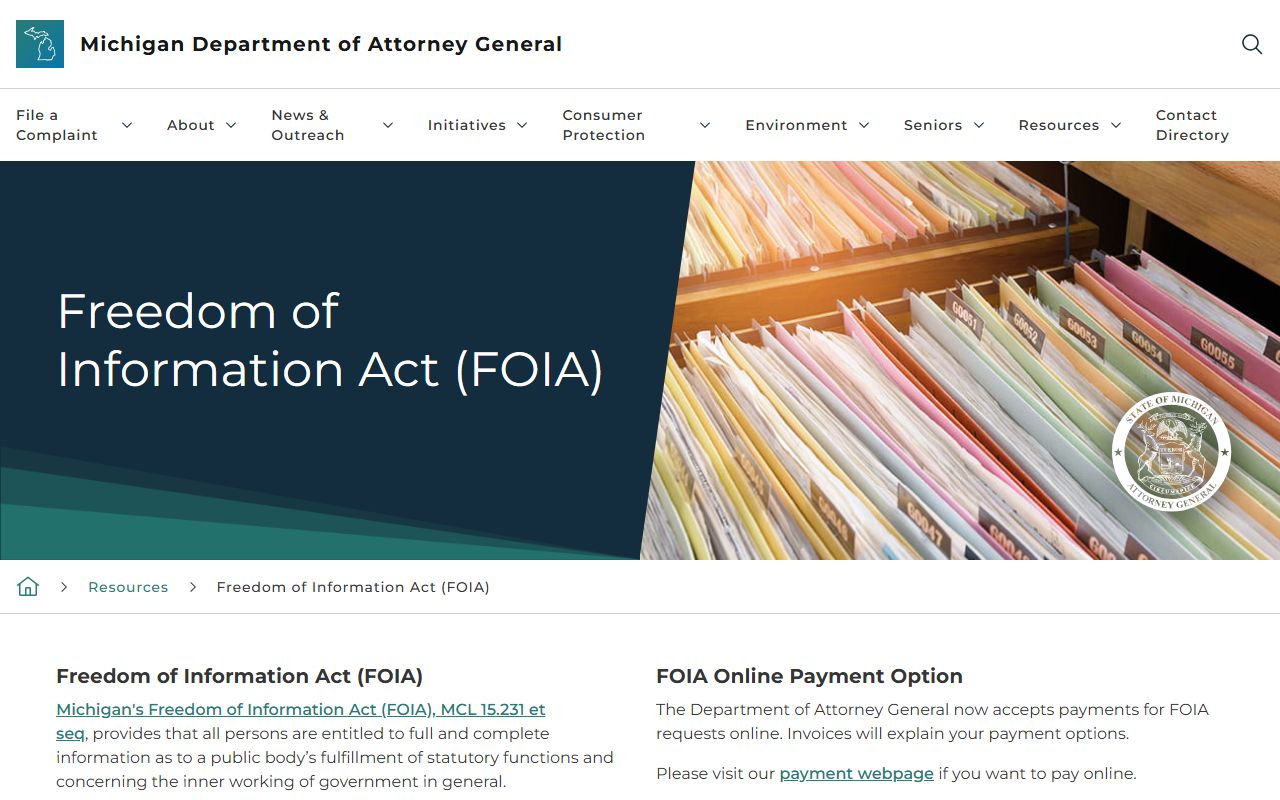
That guidance frames how a Tuscola County warrant records request should be phrased and what a public body may charge. Completed sheriff forms are delivered to 420 Court Street in Caro or emailed to the office. The office has five business days to respond and may charge a fee, with an advance estimate available. Note that some warrant information may be exempt, sealed, or tied to an active investigation.
| Field Label | Type | Required | Notes |
|---|---|---|---|
| Name of person searched for | Text | Recommended | Subject of the record request. |
| Date of birth | Date | No | Helps confirm identity if known. |
| Address, city, and ZIP | Text | No | Subject address if known. |
| Incident details | Text | Yes for a useful search | Include date, time period, incident number, and type. |
| Requester name and signature | Text | Yes | Signed and dated by the requester. |
| Phone and email | Text | Recommended | Used to notify when the request is ready. |
What a Tuscola County Warrant Record Shows
A warrant record combines court and law-enforcement information. Some fields are public once a complaint is filed or a warrant is executed. Others stay restricted or redacted. District Court filings, for example, cannot contain a date of birth, so that field is not exposed in public court documents.
The fields below reflect what a person can expect from Tuscola court and sheriff records, along with how public each one tends to be.
| Field | What It Shows |
|---|---|
| Subject name | Often public after a warrant is filed or executed, unless sealed or juvenile. |
| Date of birth | Redacted or nonpublic; barred from District Court filings. |
| Case number | Often public and searchable through MiCOURT or the court clerk. |
| CTN | Criminal tracking number shown on some public criminal docket displays. |
| Charge or offense | Often public after a complaint; may change from the arrest charge to the filed charge. |
| Issuing court | Usually public: 71B District, 54th Circuit, or another jurisdiction. |
| Bond amount or type | Often public after arraignment; confirm with the jail or court. |
| Warrant status | May be withheld; active status often requires law-enforcement confirmation. |
How to Resolve an Outstanding Warrant
An outstanding warrant does not go away on its own. Ignoring it can add costs, license problems, or a new arrest. A steady, informed approach works better. The path depends on which court issued the order and whether the matter is civil or criminal.
People who cannot afford a lawyer can ask for appointed counsel. The 71B District Court directs defendants to request an attorney for arraignment through the Michigan Indigent Defense Commission at 989-672-3799. The Michigan Indigent Defense Commission sets statewide standards so assigned counsel has the time and resources to help.
- Do not rely on a third-party website. Call the court or the Sheriff's Office directly for accurate information.
- Identify the issuing court. Traffic and misdemeanor warrants usually start in district court, felony warrants after bindover are usually circuit, and probation warrants tie to the sentencing court.
- Ask whether a court appearance, a bond, an attorney appearance, a payment, or a turn-in is required.
- For a traffic or civil-infraction default, call the magistrate office at 989-672-3790 about the amount due and any hearing.
- For a criminal matter, consult defense counsel, or contact MIDC at 989-672-3799 if you qualify for appointed counsel.
- After the matter is handled, confirm the warrant has been recalled in the court case and with law enforcement, because clearance may not update instantly.
Important: Talk with a lawyer before turning yourself in on a criminal warrant, because timing, bond, and how you appear can affect the outcome of the case.
An arrest that leads to custody moves into the jail and court systems quickly, and the booking side of that process is covered on the Tuscola County inmate records page.
Restricted Tuscola County Warrant Records
Not every warrant is open to the public. Search warrants are frequently sealed while an investigation is active, so the underlying affidavit and return may not be released. Releasing them early could compromise a case, so courts limit access by rule or order.
Juvenile warrants and juvenile case files are also restricted. Under Michigan law, juvenile records are open only by court order, and the county keeps juvenile records through a separate office. Some civil and family enforcement matters carry confidential victim or protective-order information as well.
Because access varies, the safest step is to ask the issuing court or the Sheriff's Office what is releasable in a specific case. Charge details that do become public are often clearer through the full case file, which the Tuscola County criminal court records page explains in more depth.